

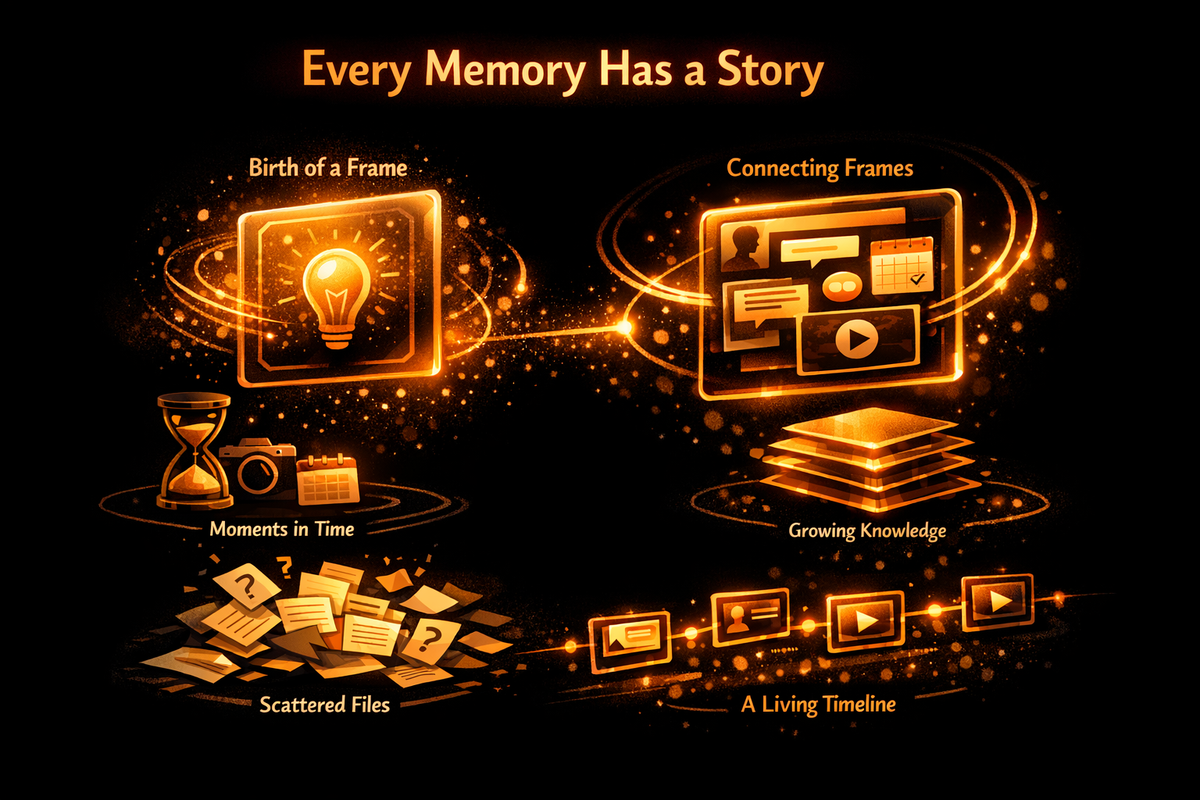
Every memory has a story.
In Memvid, that story begins long before your first document is added, and it keeps evolving as new events happen, old ones fade into the background, and knowledge grows up into something searchable, reliable, and surprisingly human.
This is the story of Memvid Smart Frames, how they’re born, how they’re raised, and how they learn to connect with each other.
First of all, Why Frames
Before Memvid, we tried storing knowledge as documents, chunks, and vectors. And every time, something important broke: ordering, context, or trust.
Real memory doesn’t arrive as isolated files; it arrives as moments in time. A conversation, a decision, a document uploaded today that suddenly matters more than everything before it.
That’s why Memvid doesn’t store documents. It stores frames. Each frame represents what was known at a specific moment, preserving both the content and the timeline it belongs to.
Memory stops being a pile of files and starts becoming a story.
What Inspired Frames
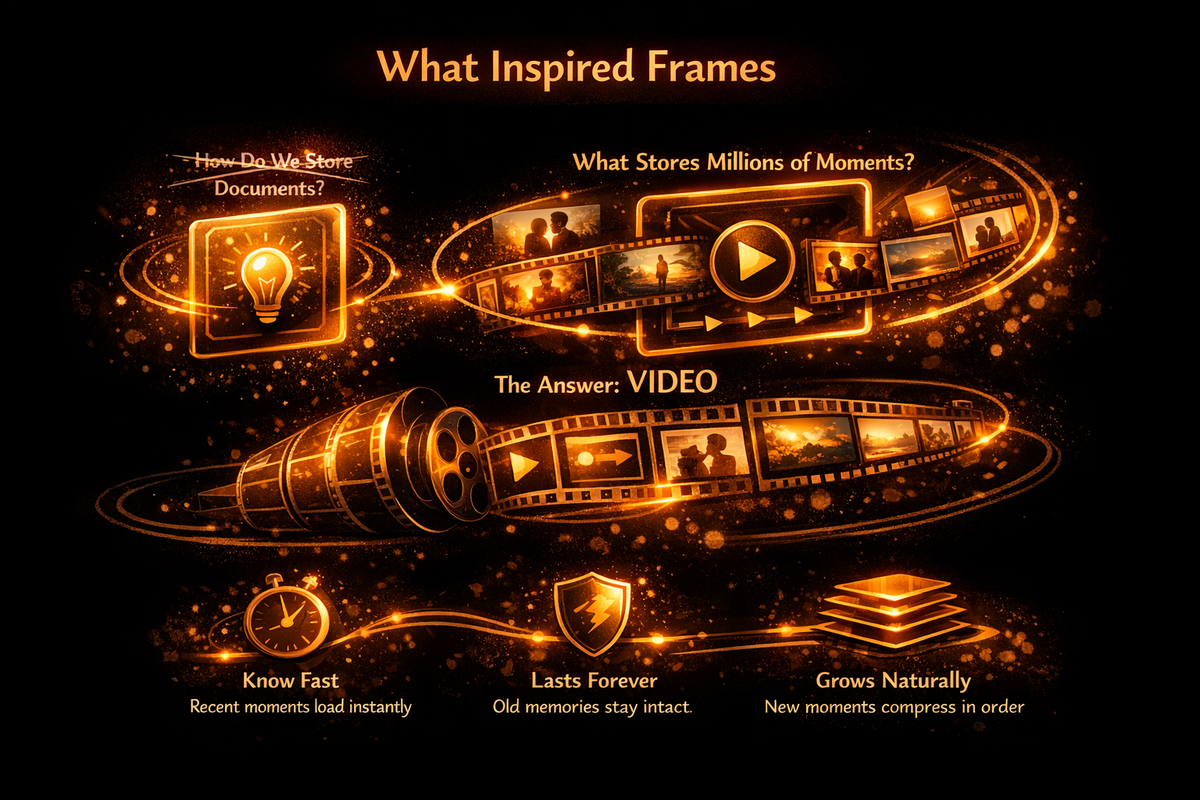
We stopped asking, “How do we store documents?”
And asked a different question: What technology already stores millions of moments, in order, safely, and lets you jump to any one instantly?
The answer was: VIDEO
A movie contains millions of frames, yet you can jump to any moment instantly, stream it safely, and recover even if part of the file is damaged.
Memvid applies that same idea to knowledge. Frames are written sequentially, grouped efficiently, and compressed together, which means searches usually require a single seek instead of multiple round trips across systems.
Because related moments live close together, recent knowledge loads faster, old knowledge stays accessible, and adding new memory never rewrites the past.
The result is a system that feels natural, fast, and resilient, because it’s built the same way life unfolds.
Born: Before the First Memory Exists
Before a single word is stored, a Memvid file already knows who it is.
When you create a .mv2 file, Memvid doesn’t wait for data to decide its shape. It builds the skeleton first, like a house framed before furniture moves in.
This skeleton includes:
- A header that identifies the file and its rules
- An embedded write-ahead log (WAL) for crash safety
- Reserved regions for frames, indices, and a table of contents
- A footer anchor that lets the file recover itself even after disaster
At this stage, the file is empty of knowledge, but not empty of structure.
Think of it as a newborn with:
- A spine (file layout)
- Reflexes (crash recovery)
- DNA (deterministic rules)
Nothing has been learned yet, but everything needed for learning is already there.
The First Breath: Frames Are Created
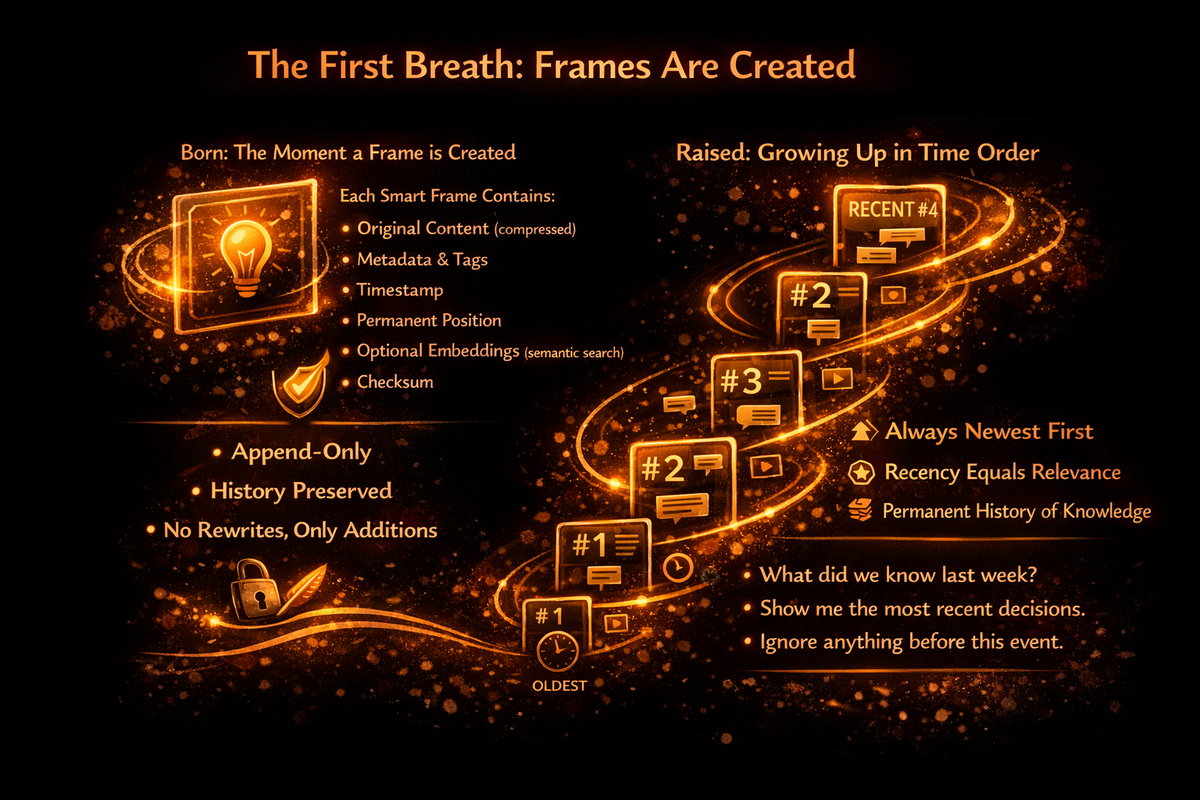
The moment you call put() — boom — a Smart Frame is born.
A frame is Memvid’s smallest unit of memory. It’s not just text or data. It’s a moment.
Each frame contains:
- The original content (compressed, never thrown away)
- Metadata (title, labels, URI, tags)
- A timestamp
- A position in the timeline
- Optional embeddings (if semantic search is enabled)
- A checksum so it can never be silently corrupted
Frames are written append-only, meaning:
- Nothing overwrites the past
- History is preserved
- Every moment has a place in time
Just like life, no rewrites, only additions.
Raised: Growing Up in Time Order
Frames don’t grow up randomly. They grow up in order.
Memvid raises frames according to the event timeline, the order in which knowledge enters your world.
That matters more than it sounds. Why?
Because recency is relevance.
- A chat from a year ago usually matters less
- A document uploaded today is often critical
- A decision made yesterday should outrank a similar one from last month
Memvid understands this intuitively.
Every frame gets:
- A timestamp
- A frame number
- A permanent position in the knowledge timeline
This allows Memvid to answer questions like:
- “What did we know last week?”
- “Show me the most recent decisions.”
- “Ignore anything before this event.”
Time isn’t metadata bolted on later, it’s part of the frame’s identity.
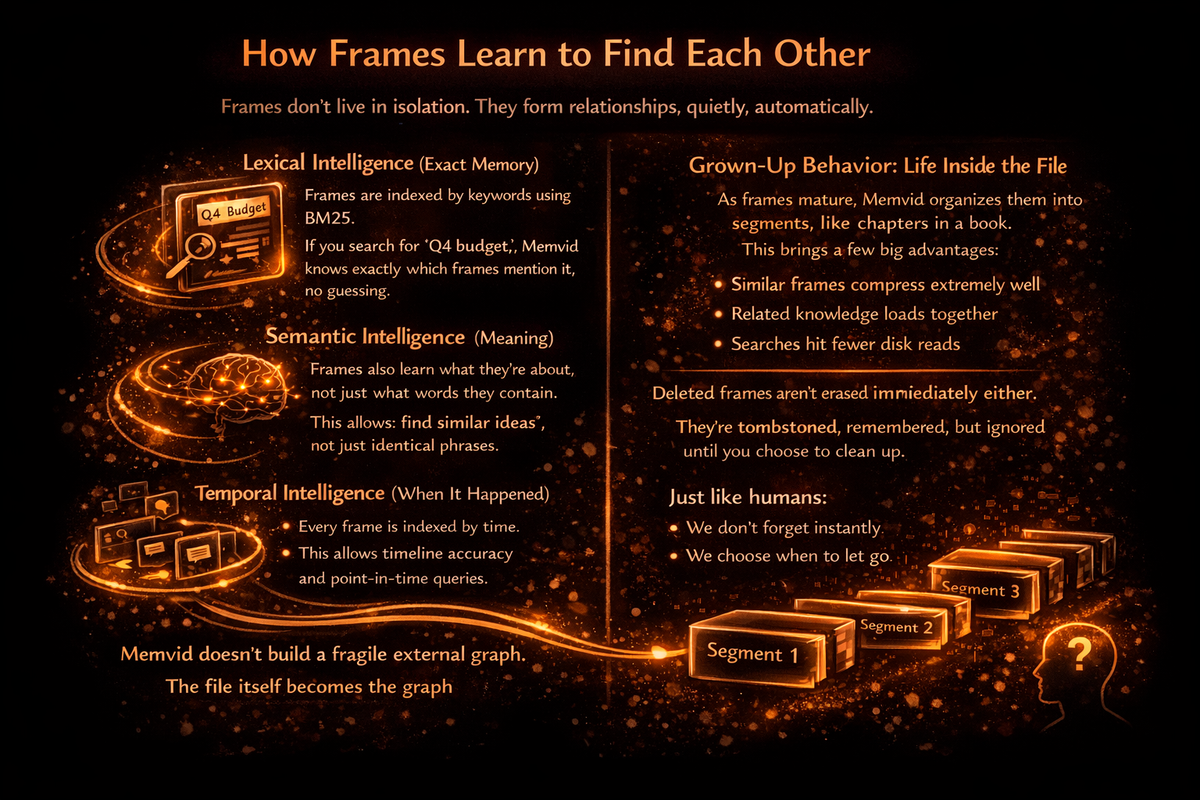
How Frames Learn to Find Each Other
Frames don’t live in isolation. They form relationships, quietly, automatically.
Inside every .mv2 file, several algorithms are constantly at work:
- Lexical Intelligence (Exact Memory)
- Frames are indexed by keywords using BM25. If you search for “Q4 budget”, Memvid knows exactly which frames mention it, no guessing.
- Semantic Intelligence (Meaning)
- Frames also learn what they’re about, not just what words they contain.
- This allows “find similar ideas”, not just identical phrases.
- Temporal Intelligence (When It Happened)
- Every frame is indexed by time.
- This allows timeline accuracy and point-in-time queries.
- Inter-Frame Linking (Context Awareness)
- Frames naturally link through:
- Shared labels
- Similar embeddings
- Proximity in time
- Common URIs or tracks
Memvid doesn’t build a fragile external graph.
The file itself becomes the graph.
Grown-Up Behavior: Life Inside the File
As frames mature, Memvid organizes them into segments, like chapters in a book.
- This brings a few big advantages:
- Similar frames compress extremely well
- Related knowledge loads together
- Searches hit fewer disk reads
- Old memories stay accessible without slowing down new ones
Deleted frames aren’t erased immediately either. They’re tombstoned, remembered, but ignored until you choose to clean up.
Just like humans:
- We don’t forget instantly
- We choose when to let go
Why This Feels So Natural
Traditional databases treat knowledge like rows in a spreadsheet.
Memvid treats knowledge like life events.
- Ordered
- Contextual
- Incremental
- Portable
- Crash-safe
- Deterministic
In short; Memvid Smart Frames are not just a storage format, they’re a philosophy. By treating knowledge as a sequence of moments rather than a pile of documents, Memvid captures what we knew, when we knew it, and how it fits into everything else.
Frames are born with structure, raised in time, connected by meaning, and preserved without rewriting the past.
The result is a single file that behaves less like a database and more like memory itself, ordered, resilient, and deeply human.